GPS measurements of crustal deformation in the Eastern Mediterranean
R. Reilinger1, B. Oral1, R. King1, S. McClusky1, and N. Toksoz1, H.-G. Kahle2, K. Kastens3, A. Barka4, G. Veis5, M. Hamburger6, and M. Prilepin7
1Massachuestts Institute of Technology; 2Eidgenössische Technische Hochschule, Zurich, Switzerland; 3Lamont Doherty Earth Observatory; 4Istanbul Tech University, Turkey; 5National Technical University, Athens, Greece; 6Indiana University; 7Institute of Physics of the Earth, Russia
Crustal velocity estimates for the period 1988 - 1994 (see figure) are providing constraints on the kinematics of crustal deformation in the Arabia-Africa-Eurasia continental collision zone, and accordingly on the rheology of the continental lithosphere and the forces responsible for active deformation. The GPS observations document northwestward motion of the Arabian plate relative to Eurasia at a rate (18 ± 4 mm/yr) that is less than, but not statistically different from, the NUVEL 1A circuit closure rate (24 ± 6 mm/yr). The motion of Arabia appears to be transferred directly to the region of Turkey north of the suture zone. However, eastern Turkey and the Caucasus are characterized by distributed deformation while central/western Turkey is characterized by rigid plate motion which results in westward displacement and counter-clockwise rotation of the Anatolian plate. The Anatolian plate is de-coupled from Eurasia along the right-lateral, strike-slip North Anatolian fault. This different response in eastern and western Turkey may result from different boundary conditions - the Hellenic arc forming a "free" boundary to the west, and the Asian continent forming a resistant boundary to the north and east. The Aegean Sea (Greece) and the Aegea rough region (Turkey) deviate significantly from rigid plate rotation. In addition to rotating with Anatolia, this region shows roughly N-S extension at a rate of ~ 15 ± 5 mm/yr. The contemporary pattern of deformation indicates increasing motions towards the Hellenic arc, suggesting that the westward displacement and counter-clockwise rotation of Anatolia is driven both by "pushing" from the Arabian plate and by "pulling", or basal drag, associated with the foundering African plate along the Hellenic subduction zone.
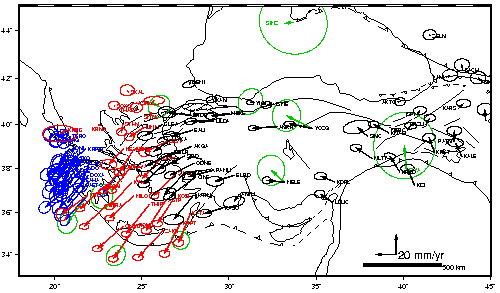
GPS and SLR (green) horizontal velocity estimates relative to Eurasia and their 95% confidence ellipses in the eastern Mediterranean region. Black vectors (MIT/ITU et al.), red (NTU-A/LDEO), blue (NTU-A/ETH-Z).